


There is a moment in childhood that every parent and grandparent has witnessed.
A child freezes.
Something feels different. A face looks unfamiliar. A room seems changed. For a split second, uncertainty rushes in.
And then, just as quickly, something familiar restores calm.
A voice. A laugh. A scent. A phrase that has been spoken a hundred times before.
Children experience the world through their senses long before they can fully explain their feelings. Familiarity is not just comforting, it is grounding. It tells them, you are safe here.
One of the most powerful sensory memories children hold onto is smell.
The Science of Familiar Scent
Smell is deeply tied to memory. In both children and adults, scent connects directly to the emotional centers of the brain.
That is why certain smells can instantly transport you back in time. A particular cologne. A favorite meal cooking. The scent of laundry from childhood.
For children, these sensory anchors are even stronger because their world is still forming.
When everything else feels uncertain, a familiar smell can cut through fear almost instantly.
It bypasses overthinking. It whispers, this is home.
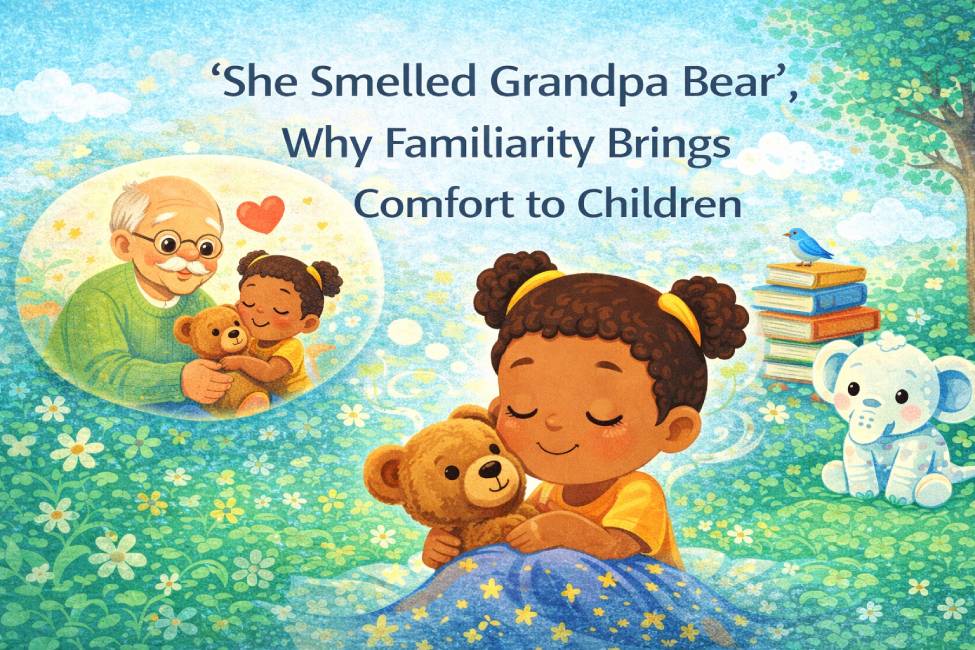
In the story Jillian Bear and the Grandpa Scare, there is a simple but powerful turning point. After waking up and believing her Grandpa has disappeared, Jillian sees a huge bear who looks almost the same, but not quite. His mustache is gone. To her eyes, he feels like a stranger.
She does not immediately calm down when someone explains it. Instead, she pauses.
She sniffs the air.
She smells her blanket. She smells Grandma Bear. And finally, she smells Grandpa Bear.
In that moment, familiarity wins.
The scent tells her what her eyes could not, this is still the same loving person.
Why Visual Changes Feel So Big
Children rely heavily on visual recognition. They identify people by hair, glasses, clothing, facial hair, even posture.
When one of those details changes suddenly, it can create confusion.
Adults understand that a shaved mustache does not alter identity. A child does not automatically make that leap. To them, the change may feel like replacement.
The fear is rarely about the physical difference. It is about what the difference might mean.
Has something been lost? Has someone changed? Is my safe person still the same?
That is why reassurance needs to go deeper than words.
The Multi Sensory Experience of Safety
Safety is rarely communicated through logic alone.
It is built through repeated sensory experiences.
The sound of a familiar nickname.
The rhythm of a grandparent’s laugh.
The feel of a well known hug.
The scent that signals home.
When children encounter uncertainty, these sensory cues work together to restore balance.
In Jillian Bear and the Grandpa Scare, the story does not rely on a lecture about appearance. It gently shows that even though something looks different, the deeper markers of love remain unchanged.
The voice is the same. The arms that hug are the same. The scent is the same.
That layered familiarity brings Jillian back to calm.
Why This Matters for Families
Understanding how strongly children respond to familiarity can change the way adults handle moments of fear.
Instead of dismissing a child’s reaction, pause and think about what sensory anchors are available.
Can you repeat a familiar phrase?
Can you sit in the same reading chair?
Can you offer the same bedtime routine?
Sometimes the solution is not a long explanation. It is a return to what feels known.
Parents and grandparents often underestimate how much their small habits matter. The way you say goodnight. The way you tuck in a blanket. The smell of your sweater when you hug.
These details become emotional markers in a child’s mind.
Turning Surprise Into Security
Change is unavoidable. Haircuts happen. Homes get rearranged. Schedules shift.
The goal is not to prevent change. It is to surround change with steady love.
Stories that highlight this truth help children practice resilience in a safe environment. When they hear about a character who feels startled and then finds reassurance through familiarity, they begin to internalize the pattern.
Fear can soften. Confusion can clear. Love remains constant.
A simple line like “She smelled Grandpa Bear” carries a profound message for young readers. Beneath appearances, beneath momentary surprise, connection still exists.
The Lasting Memory
Long after childhood, many adults can recall the scent of a grandparent’s home. The way their clothes smelled. The smell of their kitchen. The feel of their embrace.
Those memories are powerful because they are tied to security.
For children today, those same sensory experiences are shaping their emotional foundation.
So if a child reacts strongly to something that feels small to you, remember what might be happening beneath the surface. They are searching for familiarity.
Offer it to them.
Repeat the loving phrase.
Give the steady hug.
Let them pause and breathe in what feels known.
Because sometimes, the quickest path back to courage is not through explanation.
It is through recognition.
And in stories that celebrate that recognition, families find a gentle reminder that even when something looks different, the love they depend on is still right there.