


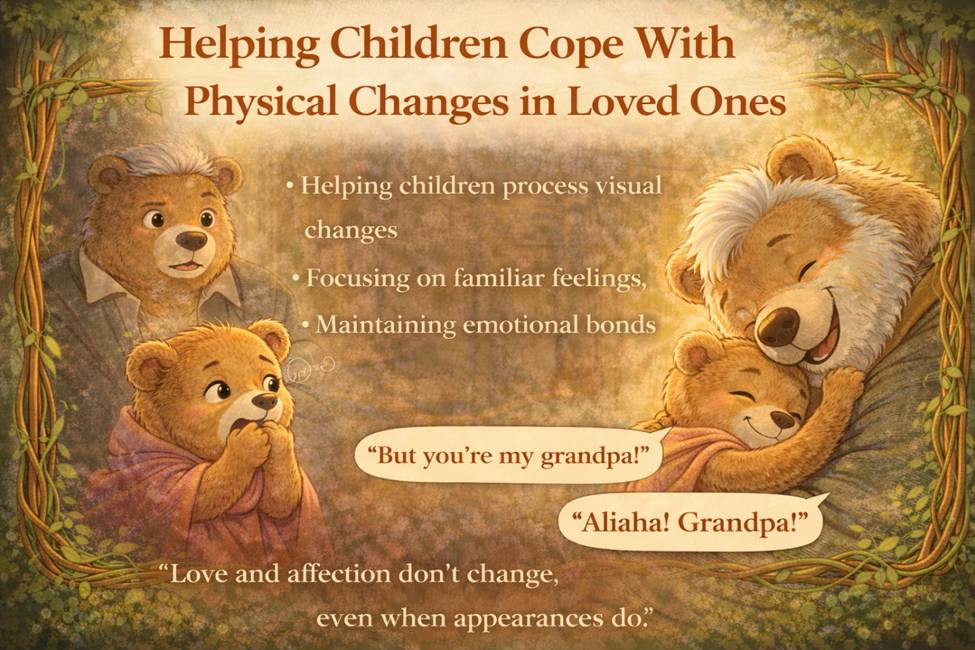
Children rely on familiarity to feel safe. A parent’s voice, a grandparent’s face, the shape of a smile — these details become part of a child’s internal map of the world. When something in that map changes, even in a small way, it can feel bigger than adults expect.
A new pair of glasses.
A shaved beard.
A dramatic haircut.
Wrinkles that seem deeper.
Hair that has turned gray.
To an adult, these are ordinary physical changes. To a child, they can be momentarily unsettling.
Young children, especially toddlers and preschoolers, are still developing facial recognition skills. They rely heavily on specific visual cues — a mustache, long hair, certain glasses — to identify the people they love. When one of those cues disappears, it can briefly disrupt their sense of certainty.
They may stare.
They may hesitate.
They may hide behind a caregiver.
They may even cry.
This reaction is not rejection. It is confusion.
And confusion, for a child, often feels like fear.
That’s why stories that normalize physical transformation are so powerful. When a child sees a character respond to a loved one’s changing appearance — and then rediscover connection — it gives them a framework for handling similar moments in real life.
Grandpa without a mustache is still Grandpa.
That simple message builds adaptability.
Adaptability begins with understanding that identity is deeper than appearance. A mustache might be a familiar feature, but it is not the essence of who someone is. Glasses may frame a face differently, but they do not change the warmth in someone’s voice or the way they give hugs.
Children need help learning that distinction.
In early development, children often equate what they see with what is true. If something looks different, it can feel different. Stories gently guide them toward a more flexible understanding: people can look different and still be the same person inside.
This flexibility is an essential life skill.
As children grow, they will encounter many visible changes in loved ones. Parents may age. Grandparents may move more slowly. A favorite teacher may cut their hair. A caregiver might begin using a cane. Over time, children will witness illness, aging, and transformation.
When we normalize small changes early on — like glasses or a missing mustache — we lay the groundwork for coping with larger changes later.
The key is not to dismiss a child’s reaction.
If a child says, “You don’t look like Grandpa anymore,” it can be tempting to laugh it off or say, “Of course I do!” But validation helps more than correction.
“You’re noticing Grandpa looks different without his mustache.”
“That surprised you, didn’t it?”
“It can feel strange when someone changes how they look.”
By naming the feeling, we help children regulate it.
After validation comes reassurance.
“Even without his mustache, Grandpa still loves you.”
“He still tells the same silly jokes.”
“He still gives the same big hugs.”
This anchors identity in relationship rather than appearance.
Stories that model this sequence — surprise, recognition, reassurance — act as emotional rehearsal. When children see a character move from uncertainty to comfort, they internalize the process.
They learn:
It’s okay to feel unsure.
I can look again.
I can listen.
I can reconnect.
That is adaptability in action.
Adaptability does not mean ignoring change. It means adjusting to it without losing a sense of safety.
For children, safety is relational. They feel secure when their relationships feel predictable. Physical changes can temporarily interrupt that predictability. Stories restore it.
Another important layer is helping children understand that change is natural.
Bodies grow.
Hair grows and gets cut.
Faces wrinkle.
Glasses help eyes see better.
Beards come and go.
When adults talk openly about these changes in everyday language, they reduce mystery. Mystery often fuels anxiety. Familiar explanations reduce it.
For example:
“Grandpa shaved his mustache because it felt itchy.”
“I’m wearing glasses now to help me read your favorite book.”
“My hair is gray because I’ve lived a long time.”
These explanations are simple but powerful. They transform change from something scary into something understandable.
Books that highlight these transitions also teach empathy. When children see a character adapt to a loved one’s physical change, they learn to extend patience rather than panic. They learn that the person they love is still emotionally available, even if visually different.
This is especially important in multigenerational families. Aging can be confusing for children. A grandparent’s slower movements or physical differences may raise questions. When stories frame these shifts gently, children are more likely to respond with curiosity instead of fear.
And adaptability, once built, extends beyond family.
A child who learns that Grandpa without a mustache is still Grandpa is also learning:
A friend with a new haircut is still my friend.
A teacher with glasses is still my teacher.
A classmate who looks different today is still the same person inside.
In a diverse and ever-changing world, this mindset matters deeply.
Ultimately, helping children cope with physical changes in loved ones is about reinforcing a simple truth: love is not attached to a hairstyle, a pair of glasses, or a facial feature.
Love lives in voice.
In shared memories.
In routines.
In affection.
In consistency.
When children understand that, they become more resilient.
They can pause when something looks unfamiliar.
They can ask questions.
They can seek reassurance.
They can adjust.
And most importantly, they can hold onto connection.
Because Grandpa without a mustache is still Grandpa.
And that message — simple, steady, and repeated — builds children who can face change without losing their sense of belonging.