


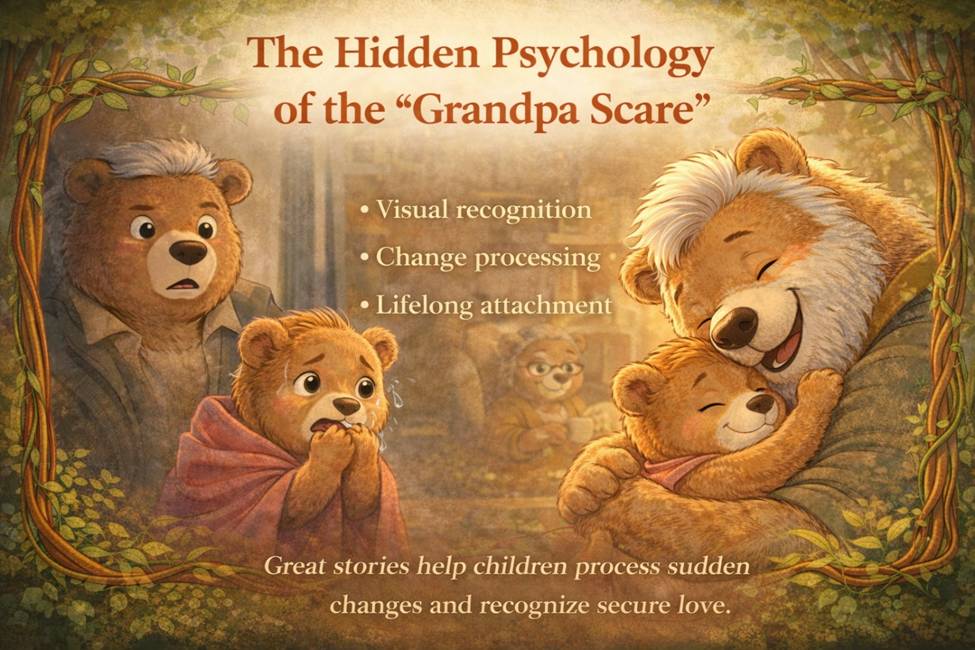
At first glance, the “Grandpa Scare” feels simple — a small misunderstanding, a brief moment of tension, and a warm resolution. But beneath that gentle storyline is a thoughtful psychological structure designed specifically for young children.
The scare is mild — and that’s intentional.
Children need opportunities to experience suspense in safe, controlled ways. When stories eliminate all tension, they can feel flat and unengaging. But when tension becomes too intense, it can overwhelm a child’s nervous system. The sweet spot lies in what psychologists often call a “safe scare.”
A safe scare allows children to feel a flicker of uncertainty without crossing into distress.
In this story, the moment of confusion follows a classic and effective pattern:
• Something is different.
• It feels big.
• It seems threatening.
• It turns out to be safe.
This structure mirrors the rhythm of many beloved childhood stories — from peekaboo games to gentle hide-and-seek narratives. The brain registers change. The body prepares for alertness. Then relief arrives. That relief is not just comforting — it is instructive.
When Jillian notices that something about Grandpa feels different, her reaction reflects how children naturally process unfamiliar stimuli. Young children rely heavily on predictability. When a familiar person looks different, the brain briefly categorizes that difference as potential risk. It’s not dramatic. It’s protective.
For a moment, the change feels big.
To adults, a missing mustache or a shifted appearance might seem minor. But children experience the world in magnified proportions. Small visual changes can feel significant because they disrupt a known pattern. The story honors that experience rather than dismissing it.
Then comes the perception of threat.
Importantly, the story does not present real danger. The “threat” exists only in interpretation. This is what makes the scare psychologically safe. The child reader feels suspense, but the environment remains secure. There is no actual harm, no chaos, no instability in relationships.
And finally, the reveal: it turns out to be safe.
This final step is crucial. The nervous system moves from alertness back to calm. That shift teaches resilience. Each time a child experiences this arc — surprise, tension, relief — their brain practices emotional regulation.
Over time, that practice builds confidence.
Children begin to internalize a powerful lesson: not every surprise is danger.
This learning extends beyond the page. In real life, children encounter countless small surprises — a teacher rearranging desks, a parent wearing new glasses, a loud noise outside, a grandparent shaving facial hair. If their only experiences of surprise are overwhelming or frightening, they may become hypervigilant.
But when stories consistently show that many surprises resolve safely, children develop flexibility.
They learn to pause instead of panic.
They learn to look closer.
They learn to gather information before concluding threat.
Perhaps most importantly, they learn that sometimes change is just change.
Change does not automatically equal loss.
Difference does not automatically equal danger.
Unfamiliar does not automatically mean unsafe.
The “Grandpa Scare” models this beautifully. It validates the initial reaction without reinforcing fear. It shows that feeling startled is normal — and temporary. The relationship remains intact. Love remains steady. Safety was present all along.
That stability is the hidden anchor of the story.
By allowing children to feel a mild scare and then experience relief, the book strengthens their emotional muscles. It’s a rehearsal for real life. Each safe resolution teaches the brain, “I can handle this.”
In a world where children will inevitably face unexpected moments, that quiet confidence matters.
Because when a child understands that not every surprise is danger, they step into the world with more curiosity and less fear.
And that is the quiet psychological brilliance of the “Grandpa Scare.”