


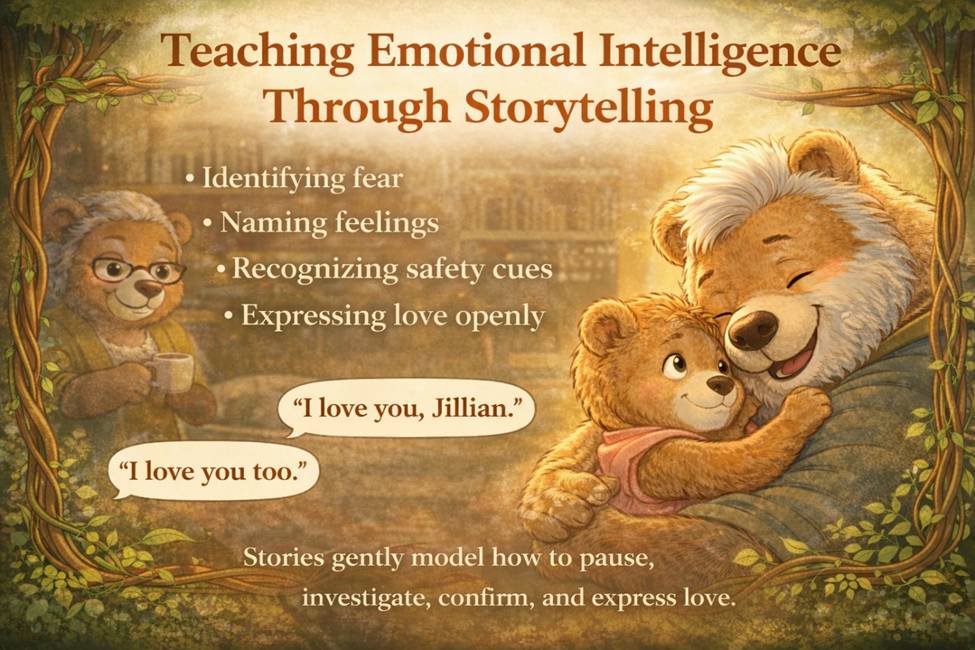
Children don’t learn emotional regulation from lectures. They learn it from experience, observation, and modeling. You can tell a child to “calm down” a hundred times, but those words alone won’t teach them how to calm down. What truly shapes emotional intelligence is watching what happens in emotionally charged moments — and seeing those moments handled with steadiness.
That’s where storytelling becomes powerful.
In this story, Jillian experiences fear. Something feels different. For a brief second, her body reacts. But instead of the scene erupting into chaos, the story slows down.
She sniffs.
She observes.
She processes.
That pause is everything.
Rather than running away in panic or being instantly rescued, Jillian moves through a sequence that mirrors healthy emotional regulation. The story gently models three foundational steps:
Pause.
Investigate.
Confirm.
First, she pauses. This is the beginning of regulation — the space between stimulus and response. Young children often react immediately to fear. By showing Jillian taking even a small beat before escalating, the story demonstrates that feelings can be noticed without being acted on instantly.
Next, she investigates. She gathers more information. She uses her senses. She looks closer. This teaches children that fear is not always a final conclusion — sometimes it’s a question mark. Investigation builds critical thinking alongside emotional awareness.
Finally, she confirms. She recognizes the safety cue. The unfamiliar becomes familiar again. Her nervous system settles because she has verified that she is safe.
These are early emotional regulation skills in action.
Stories like this become practical tools for parents and caregivers. After reading, adults can gently reflect with children:
“Did Jillian feel scared at first?”
“What helped her figure out she was safe?”
“What did she notice?”
Through these conversations, children practice identifying fear. They begin to understand that fear is a feeling, not an identity. It comes and goes.
The story also supports naming feelings. Instead of labeling Jillian as “silly” or dismissing her reaction, the narrative honors her experience. This validates the child reader’s own emotional world. When children see feelings acknowledged on the page, they feel permission to acknowledge their own.
Recognizing safety cues is another critical lesson. Jillian doesn’t just stop being afraid randomly — she uses information. A familiar smell. A familiar voice. A loving tone. These cues signal security. Teaching children to notice safety cues helps them build resilience. It gives them tools to self-soothe.
And then comes the most important piece: expressing love openly.
When Grandpa says, “I love you, Jillian,” and she responds, “I love you too,” the exchange models secure attachment language. It shows that emotional moments — even ones that begin with fear — can end with connection.
This matters deeply.
Children who regularly hear and reciprocate loving language build a strong internal sense of worth and belonging. The story doesn’t just resolve fear; it reinforces relationship. It demonstrates that emotions do not threaten attachment. Fear doesn’t push love away.
In fact, love becomes the anchor.
Through simple modeling, the story teaches children how to move through big feelings safely. It shows them that emotions can be noticed, explored, understood, and soothed — all within the safety of connection.
And that is emotional intelligence in its earliest, most beautiful form.