


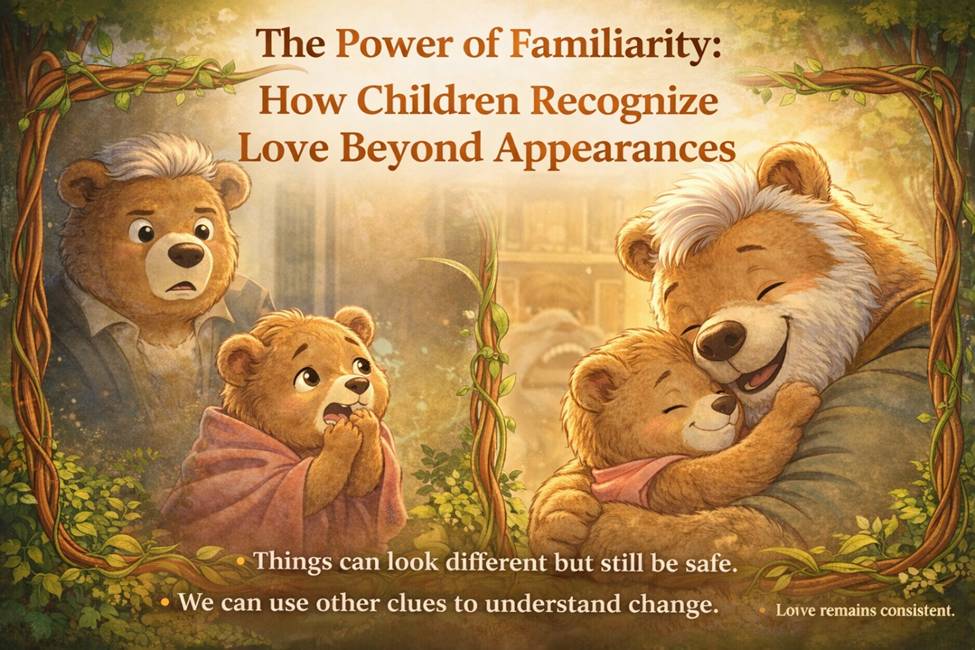
One of the most touching moments in Jillian Bear and the Grandpa Scare comes when Jillian realizes that the “new HUGE bear” standing before her is actually Grandpa Bear.
At first, she doesn’t recognize him.
For adults, that might seem surprising. But from a developmental perspective, it makes perfect sense. Young children rely heavily on visual familiarity. Their brains use prominent features — a beard, a hairstyle, glasses, specific clothing — as shortcuts for recognition. When one of those features’ changes, it can temporarily disrupt their sense of certainty.
A haircut, a shaved beard, or a new pair of glasses can completely alter a child’s perception. That’s not overreaction. That’s developmental psychology.
To Jillian, Grandpa hasn’t just changed — he has disappeared. In his place stands someone enormous and unfamiliar. Her fear is not irrational. It is her brain trying to reconcile a mismatch between memory and present reality.
And then the story introduces a beautiful metaphor: bears may not have the best eyesight, but they have very good noses.
This simple line carries profound meaning.
It suggests that recognition — and love — go deeper than what we see. When visual certainty fails, Jillian turns to another sense. She sniffs the air. She smells her blanket. She smells Grandma Bear. She smells Grandpa Bear.
Through scent, she reconnects.
Recognition shifts from sight to instinct.
For children, this moment is powerful. It models flexibility. It shows that when one cue feels confusing, there are others we can rely on. A voice. A smell. A laugh. A familiar phrase. These are identity markers too.
More importantly, it teaches that love is not erased by surface change.
Grandpa may look different. He may seem bigger or unfamiliar without his usual features. But his scent — a symbol of his essence — remains the same. His identity remains intact. His love remains steady.
That realization builds resilience.
Children begin to internalize three key lessons:
• Things can look different but still be safe.
• We can use other clues to understand change.
• Love remains consistent, even when appearances shift.
In a world where change is constant — new environments, new routines, growing bodies, aging grandparents — this message is grounding. It helps children approach difference with curiosity rather than fear.
For parents, this moment opens the door to meaningful conversations.
“Remember when Grandpa cut his beard?”
“How did that feel at first?”
“What makes Grandpa still Grandpa?”
These questions help children think beyond the surface. They encourage reflection on what truly defines a person — their voice, their kindness, their warmth.
The story gently moves children from visual dependence toward deeper recognition. It reassures them that identity is more than appearance, and that connection can be rediscovered even when something looks unfamiliar.
Ultimately, Jillian Bear and the Grandpa Scare reminds us that love is not something we merely see.
It’s something we sense.
And sometimes, when we look beyond appearances, we find that what matters most was never gone at all.