


Separation anxiety is a completely normal part of early childhood, especially between ages two and six. During these years, children form strong attachments to the people who care for them. They depend on predictability. They expect the adults they love to be present, visible, and consistent.
So when that consistency shifts — even briefly — anxiety can surface.
In this bear story, Grandpa is present, loving, and steady before Jillian’s nap. She falls asleep in security. But when she wakes and he is no longer immediately beside her, something feels different. That subtle disappearance is enough to trigger uncertainty.
And that reaction is realistic.
Young children don’t yet have a fully developed understanding of time or object permanence in complex situations. Even a short absence can feel big. Their minds may race ahead of the facts: Where did he go? Why isn’t he here? Am I alone?
What this story gets exactly right is that it validates that fear.
Jillian doesn’t immediately understand what’s happening. She worries. She cries. She feels the disruption. The story does not rush to correct her or minimize her reaction. It allows the emotional moment to breathe.
Too often, children’s fears are dismissed with phrases like, “Don’t be silly,” or “There’s nothing to be scared of.” While well-intentioned, those responses can unintentionally communicate that the child’s feelings are wrong.
This story handles that beautifully.
The affectionate phrase “Jilly Bear, you silly bear” is not dismissive. It is rooted in warmth and familiarity. It’s a nickname wrapped in love, not criticism. The tone matters. Instead of shaming the fear, it softens it. It reassures without invalidating.
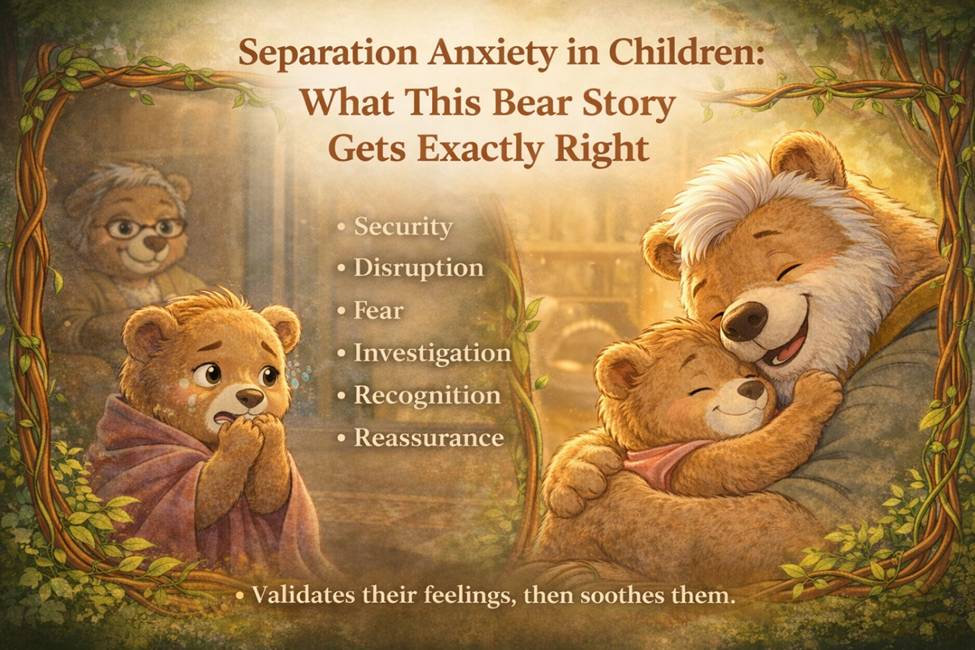
The emotional arc of the story mirrors how children genuinely process unexpected change:
- Security – Jillian feels safe before her nap.
- Disruption – She wakes and something is different.
- Fear – Anxiety surfaces as she tries to make sense of it.
- Investigation – She observes, sniffs, and gathers clues.
- Recognition – She realizes she is safe.
- Reassurance – Love is expressed openly and clearly.
This progression is psychologically sound. It reflects how children move from attachment security through disruption and back to regulation. The key is that reassurance comes after processing — not instead of it.
Because the story follows this natural pattern, it becomes more than entertainment. It becomes a rehearsal space.
Children can experience the feelings safely on the page. They can see that fear does not last forever. They can watch the return to connection.
That makes the book especially valuable for real-life transitions such as:
- Grandparent visits
• Sleepovers
• Daycare drop-offs
• Adjusting to new routines
Each of these situations can trigger separation anxiety. Reading a story that mirrors the emotional journey helps children build confidence. It gives them a template: I can feel scared. I can look for clues. I can find reassurance.
Stories like this don’t eliminate anxiety — and they shouldn’t. Instead, they normalize it and show children how to move through it.
And in doing so, they strengthen something even more important than bravery: secure attachment.