


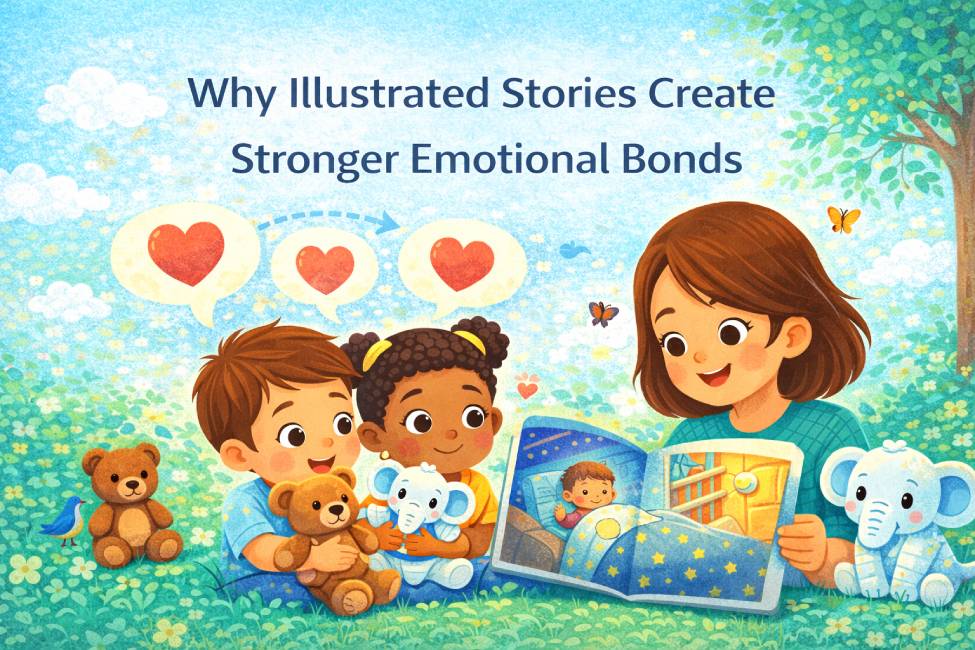
There is something magical about watching a child study an illustration.
They do not just glance at the page. They linger. They trace shapes with their fingers. They point to tiny details adults might miss.
Before many children can read words, they read pictures.
Illustrations are not just decorative in children’s books. They are emotional guides. They shape how a story is felt as much as how it is understood.
When done thoughtfully, illustrated stories create stronger emotional bonds between the child, the characters, and even the adult reading alongside them.
Pictures Make Feelings Visible
Young children are still learning to interpret complex emotions. They may not yet understand abstract language about fear, confusion, or relief.
But they understand facial expressions.
They recognize wide eyes. Slumped shoulders. A trembling lip. A soft smile.
When an illustration shows a small bear staring up at a figure who suddenly looks unfamiliar, the emotion becomes tangible. The child does not need a long explanation. They see the worry.
And when that same bear melts into a hug a few pages later, the relief is just as clear.
In Jillian Bear and the Grandpa Scare, the visual shift between fear and comfort plays a central role. The size difference between the little bear and the “huge” figure in the doorway amplifies the initial uncertainty. Later, the embrace fills the page with warmth.
Children feel that transformation visually before they even process it verbally.
Illustrations Slow the Story Down
In a fast paced world, illustrated books naturally encourage pause.
You cannot rush an image the way you might skim text. Each page invites attention.
Children often stop to ask questions about what they see.
“Why does she look sad?”
“Why is he so big?”
“Is that the same Grandpa?”
These pauses deepen connection.
The adult reader has the opportunity to respond gently, to validate feelings, and to explore the scene together.
That shared attention builds emotional closeness.
Visual Familiarity Reinforces Security
When characters are illustrated consistently throughout a book, children begin to recognize them visually.
The shape of Grandpa’s face. The curve of his smile. The cozy look of Grandma’s chair. The familiar blanket on the floor.
These repeated visual cues create stability.
In a story where a physical detail changes, like a missing mustache, the contrast becomes meaningful. The child reader can see the difference clearly.
But they can also see what remains the same.
The same kind eyes. The same posture. The same loving embrace.
Illustrations help children visually process the concept that change in one detail does not erase identity.
Art Creates Memory
Think back to a book from your own childhood. Chances are, you remember the pictures more vividly than the exact wording.
Illustrations embed themselves in memory.
For children today, the image of a small bear sniffing the air to recognize her Grandpa may linger long after the book is closed.
That image becomes a reference point. A reminder that familiarity can restore calm.
Visual storytelling often makes emotional lessons stick in a way text alone cannot.
Encouraging Conversation Through Art
Illustrated books naturally open doors to dialogue.
Instead of asking, “How do you think she feels?” you can point and say, “Look at her face. What do you notice?”
Children who struggle to articulate emotions verbally may find it easier to describe what they see.
“She looks scared.”
“He looks happy.”
“She feels better now.”
That practice builds emotional literacy without pressure.
Books like Jillian Bear and the Grandpa Scare provide simple, expressive visuals that make those conversations accessible. The large scale of the “huge” bear emphasizes the child’s perspective. The final hug visually communicates reassurance more powerfully than words alone.
The Shared Experience
There is also something deeply bonding about sitting close and looking at the same page.
Your child leans into you. You both focus on the illustration. You trace the shapes together.
The act of reading an illustrated story is relational.
It creates a shared emotional journey. You see the fear together. You experience the relief together.
That shared experience strengthens trust.
Why It Matters
In stories about family bonds, especially those centered around grandparents and grandchildren, illustrations amplify warmth.
They show the size of the hug. The softness of the setting. The gentleness of the moment.
In a world filled with moving screens and rapid animation, there is something grounding about a still image that invites reflection.
Illustrated stories do not just tell children that love is steady.
They show it.
And when a child sees, again and again, that even when something looks different, the embrace remains the same, that visual message becomes part of their emotional foundation.
That is the quiet power of pictures on a page.